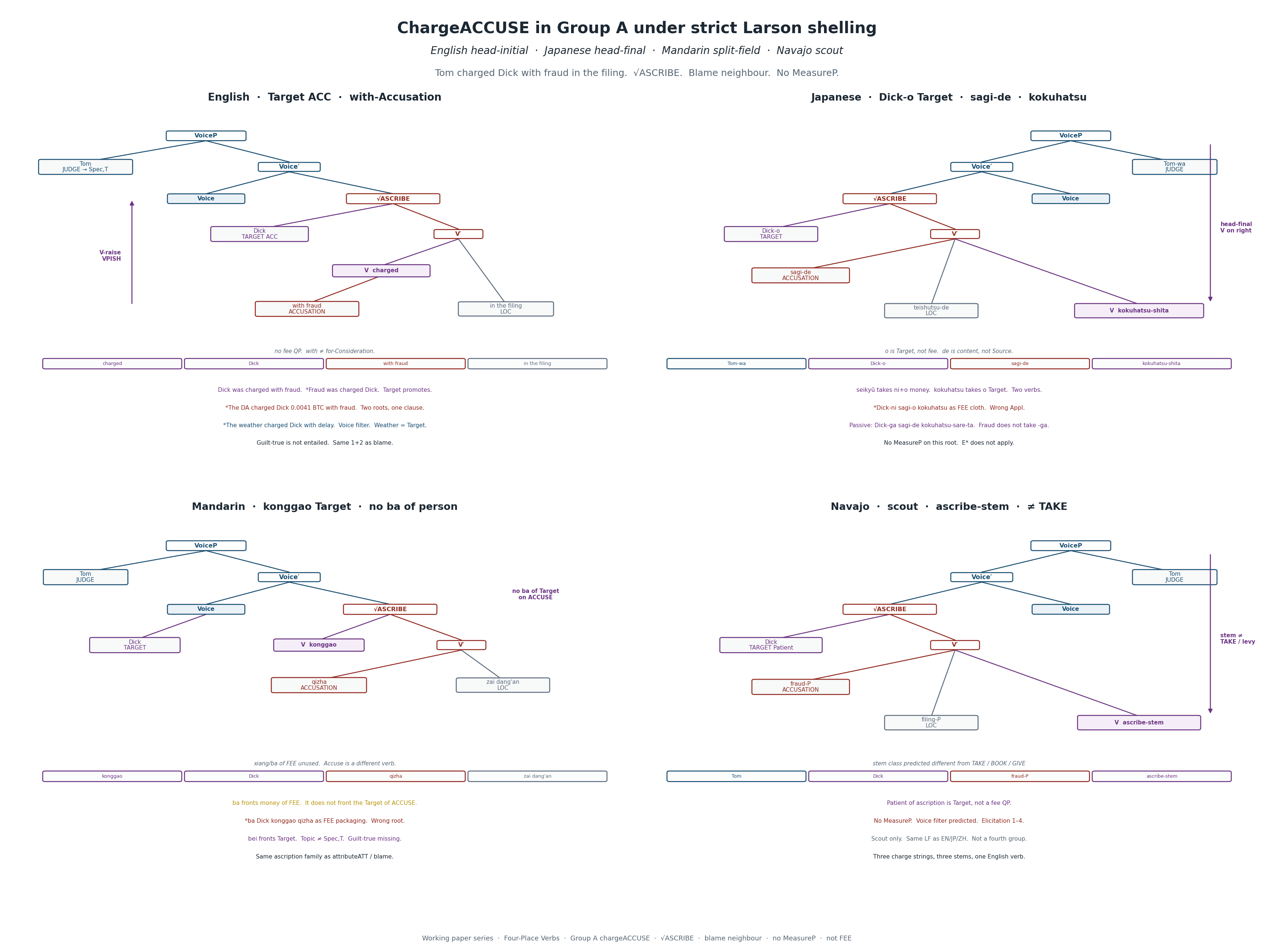
One logical form, four clothes. English charged, Japanese kokuhatsu-shita, Mandarin 控告了, and a predicted Navajo ascribe-stem. Head-initial, head-final, split-field, scout.
EN · JP · ZH transcribedNavajo scout / predictedGroups B–D not restated
Sense page for chargeACCUSE. Sister senses: chargeFEE · chargeACCOUNT. Index 2 does not list charge, so this root is not a row on the language tables. Japanese, Mandarin, and Navajo on this page are the Group A paper.
Working paper.
This entry restructures the Group A extract. It does not restamp ChargeACCUSE_GroupA_Larson_Shells, Negative_Questions_Charge_GroupA_Contrast_Set, or the Group B–D derivation files. Numbered Merge steps build Judge, Target, Accusation, and a Loc adjunct. They are not a fifth shell.
Constructed examples.
The paper’s Japanese and Mandarin sentences diagnose packaging. They do not replace elicitation. English examples below are the paper’s examples, not a corpus citation of spontaneous speech.
Scout.
The Navajo section is a prediction. Elicitation 1–4 is open. Nothing in that section is elicited data. It is not a fifth group.
Why Group A last
Group A is not a family. It is the contrast set that moves the unit of FEE into a #P, a measure word, or a stem. ACCUSE has no unit, so the diagnostic is negative: double-o unused, 把 unused, no second Patient on the ascribe stem. English still hides three roots in charge. Japanese and Mandarin name the root. Navajo is predicted to name it as a stem class.
Group A waited until B, C, and D were stable. Romance gave theme vowel and auxiliary. Inner-European gave Focus, cluster, and genitive of negation. Germanic gave particle and V2. Group A varies headedness and measuring locus. It does not vary arity.
Not in this numeration: MeasureP, ApplFROM, a Platform, a Counterparty. chargeACCUSE is 1+2 plus a Loc adjunct. The FEE verb is charge / seikyū / 收 / levy-stem. with ≠ for, o ≠ money-o, 把 of the Target is the wrong cloth, and TAKE ≠ ascribe.
The same formula is written for Japanese (CHARGE(e, sagi), LOC(e, teishutsu)) and for Mandarin (JUDGE(e, 汤姆), TARGET(e, 迪克), CHARGE(e, 欺诈), LOC(e, 档案)). The Navajo scout note repeats the English formula and says the stem spends Patient = Target. That repetition is predicted, not elicited.
Light noun, compound, and stem class package √ASCRIBE. They are not a fourth conjunct. Headedness and measuring locus change the host. They do not grow a MeasureP on this root.
Four operations
None of them add a fourth argument. The working paper’s language pages color Merge, Agree, Move, and filters green / teal / violet / red. Here those four are celadon, indigo, gold, and cinnabar.
Merge
Judge, Target, and Accusation are selected. Loc adjoins. MeasureP, ApplFROM, 把 of money, and a double-o second object are not in the numeration.
Agree
T / Asp / Mode agrees with the Judge. v or the stem agrees with the Target. Japanese o and the predicted Navajo Patient are that second relation. 把 does not Agree: there is no Incremental Theme for it to front.
Move
English raises V to T and the subject to Spec,T. Japanese and the predicted Navajo stem stay on the right. Mandarin is split-field: V sits between Judge and Target. Passive copies the Target. Topic and wa are not Spec,T.
Filters
Voice: the weather is not a Judge. The accusation stays a P. E* / F* are vacuous — no unit. Double-o unused. 把 of the Target is out. The ni+o FEE cloth is out on kokuhatsu. Inverse ≠ HAVE. Two roots do not share one clause.
Morphology map
Derivational packaging of √ASCRIBE, then inflection. T, Asp, Mode, and passive Voice are inflectional. The four columns are the paper’s; the Navajo column is scout.
English
Japanese
Mandarin
Navajo scout
Exponent
charged
kokuhatsu-shita
控告了
ascribe-stem
Derivational
√CHARGE_ACCUSE hidden in one verb. v = ∅. T = -ed. V to T.
Light N kokuhatsu + shi + ta. Head-final. de = content P.
Listed compound 控告 + 了. Split-field. 把 unused.
Ascribe-class stem + mode. Patient in the stem. Predicted.
Packaging
ACC Target. with = Accusation. for = FEE Consideration. Two P’s.
o = Target, not money. de = content, not Source. seikyū is FEE.
Postverbal Target. 把 fronts FEE money, not this Target. 向 unused.
Patient = Target. fraud-P. ≠ TAKE / BOOK / GIVE stem.
Move / filter
V → T. Dick was charged.*Fraud was charged Dick. Voice filter.
V stays right. Dick-ga … sare-ta. Double-o unused. -sase- is outer.
被 fronts Target. Topic ≠ Spec,T. *把迪克控告了.
Head-final stem. doo … da. Inverse ≠ HAVE. Elicit 1–4.
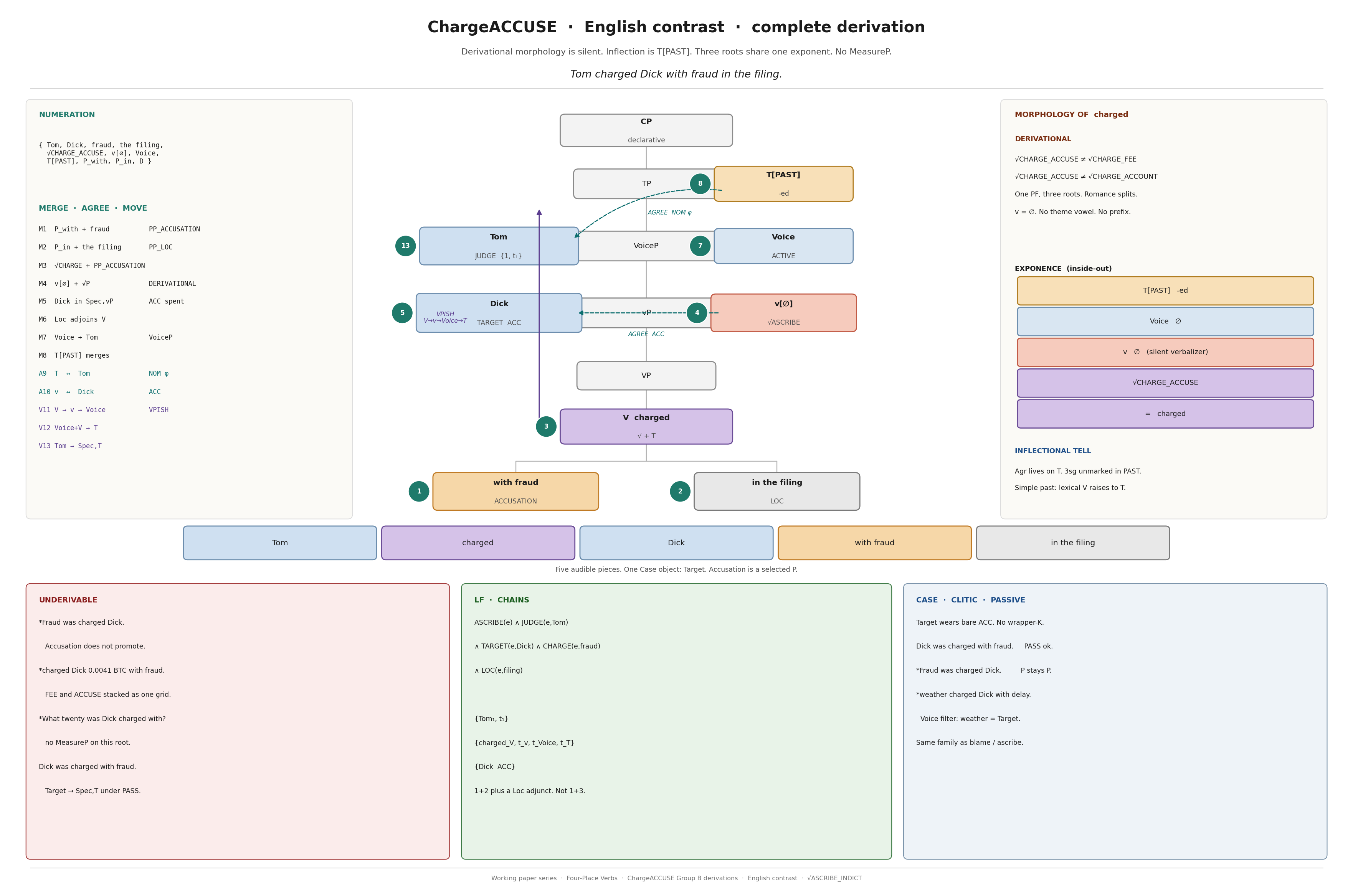
English derivation plate, ChargeACCUSE Group A. The numbered steps below follow this spread. Groups B–D are not on this plate.ChargeACCUSE Group A Larson shells. Navajo on this plate is the scout column (predicted stem, elicitation open), not an Index 2 citation. The paper says these steps do not restamp the shell figure.
Index 2
Index 2 does not list charge. It files the attitude class as English blame, credit, attribute and their class-mates in Spanish, French, Italian, Hungarian, Bulgarian, Polish, German, Dutch, and Norwegian. Those are neighbour citations, not translations of chargeACCUSE. Japanese, Mandarin, and Navajo forms on this page come from the Group A paper. Navajo remains scout.
English is a Group A language here, not only a contrast. charged hides three roots. This page is √CHARGE_ACCUSE. The Target is accusative. with is the Accusation. for on chargeFEE is Consideration. The two P’s are not one head. There is no MeasureP. The voice filter refuses weather as Target in the example the paper stars, and the shared filter list refuses weather as Judge.
Working-paper example
Tom charged Dick with fraud in the filing.
Judge · TargetACC · Accusationwith · Locin
Numeration
{ Tom, Dick, fraud, the filing, √CHARGE_ACCUSE, v[∅], Voice, T[PAST], P_with, P_in, D }
Merge, Agree, Move
M1Pwith + fraud → PPACCUSATION
M2Pin + the filing → PPLOC
M3√CHARGE + PPACCUSATION → √P
M4v[∅] + √P (silent verbalizer)
M5Dick in Spec,vP — ACC spent
M6Loc adjoins V
M7Voice + Tom → VoiceP
M8T[PAST] merges
A9T ↔ Tom · NOM + φ
A10v ↔ Dick · ACC
V11V → v → Voice (VPISH)
V12Voice+V → T
V13Tom → Spec,T
Spine
Head-initial. Traces, not a redraw of the shell figure.
CP — head-initial
TP — finite clause · T[PAST] -ed
Tom — JUDGE · {1, t₁} · Spec,T
VoiceP — external argument · Voice ACTIVE
Dick — TARGET · ACC
vP — √ASCRIBE · v[∅] silent verbalizer
V — charged · √ + T, one word
with fraud — ACCUSATION · selected P
in the filing — LOC · adjunct P
Move: V → v → Voice → T. Subject in Spec,T. Agree: T ↔ Tom (NOM, φ); v ↔ Dick (ACC).
Morphology of charged
√CHARGE_ACCUSE ≠ √CHARGE_FEE. Same English verb, two numerations. v is null. There is no light noun and no particle. with is not the for of FEE. Inside-out: T[PAST] -ed, Voice ∅, verbalizer ∅, root CHARGE_ACCUSE, spelled charged. Agreement lives on T. Simple past is V raised to T. Passive is was charged, Target nominative. Five audible pieces, and with ≠ for: Dick was charged with fraud.
Underivable
*The DA charged Dick 0.0041 BTC with fraud. Two roots, one clause.
*Fraud was charged Dick. The accusation does not promote.
*The weather charged Dick with delay. Voice filter. The paper’s gloss on this star is “weather = Target”; the shared filter line is “*weather as Judge.”
*What twenty was Dick charged with. No MeasureP. E* is vacuous.
Case, passive, family
Target is bare accusative; with is a selected P. The payer-accusative of FEE is a different cloth. Passive: Dick was charged — Target to Spec,T. Chains: {Tom₁, t₁}, {charged_V, t_v, t_Voice, t_T}, {Dick ACC}. Family: blame / ascribe / attribute. ATT.make is outer Voice, not ACCUSE.
English is the language that hides three charge roots in one past-tense word. Japanese, Mandarin, and Navajo name the root. The logical form does not change when they do.
How the paper reads the English page
Japanese · kokuhatsu-shita
kokuhatsu-suru is a light noun plus suru. The clause is head-final. o marks the Target, not money. de marks the Accusation, not a Source. seikyū-suru is the FEE verb (ni Payer + o #P). Double-o is unused because there is no second o-object. -sase- is outer Voice. Keigo is not invented here.
Constructed packaging example · not elicitationTom-wa Dick-o sagi-de kokuhatsu-shita teishutsu-de.Tom-TOP · Dick-ACC · fraud-DE · accuse-do-PAST · filing-DE The paper slots sagi as CHARGE and teishutsu as LOC. Two de’s are two heads.
Numeration
{ Tom, Dick, sagi, teishutsu, N_kokuhatsu, v_shi, Voice, T[PAST]=ta, K_o, P_de, D }
Merge, Agree, Move
M1sagi + de → PPACCUSATION
M2teishutsu + de → PPLOC
M3Nkokuhatsu + PPACCUSATION
M4vshi + that (light do)
M5Dick-o in Spec,vP — ACC
M6Loc adjoins V
M7Voice + Tom-wa → VoiceP
M8T[PAST] = ta merges
A9T ↔ Tom · NOM / wa
A10v ↔ Dick-o · ACC
V11V stays head-final
V12shi + ta suffix on N
Spine
CP — head-final · ka at C
TP — suffixes V · T[PAST] -ta
Tom-wa — JUDGE · topic / NOM
VoiceP — Voice ACTIVE
Dick-o — TARGET · ACC
vP — √ASCRIBE · vshi light do
V — kokuhatsu-shita · N + shi + ta
sagi-de — ACCUSATION · selected P
teishutsu-de — LOC · adjunct P
Agree: T ↔ Tom (NOM / topic); v ↔ Dick-o (ACC). de does not Agree with T. -sase- is a higher Voice.
Morphology of kokuhatsu-shita
kokuhatsu is a listed light noun. shi is the verbalizer (√SURU). de is P, not a second o. seikyū is a different light noun. Inside-out: T[PAST] -ta, Voice ∅, light doshi, event noun kokuhatsu, spelled kokuhatsu-shita. Past -ta suffixes the light verb. Passive: kokuhatsu-sare-ta. Causative: kokuhatsu-sase-ta.
Underivable
*Dick-ni sagi-o kokuhatsu-shita. FEE cloth on the ACCUSE verb.
*Dick-o sagi-o kokuhatsu-shita. Double-o. No second Patient.
*Sagi-ga Dick-o kokuhatsu-sare-ta. Content does not take -ga.
*ikura kokuhatsu-shita. No MeasureP. E* is vacuous.
Case, passive, family
Dick-o is accusative Target. sagi-de is the selected P. The ni of seikyū is FROM, not this o. Passive: Dick-ga sagi-de kokuhatsu-sare-ta — Target to Spec,T under PASS. A -sase- causee in ni is not the Target o. Chains: {Tom-wa}, {kokuhatsu-shi-ta}, {Dick-o ACC}, {sagi-de}. Family: hinan-suru / kizo-suru.
Japanese names the root English hid and keeps V on the right. The light noun is derivational packaging, not a fourth argument. Double-o is the ceiling that would fire if a FEE MeasureP were added to this clause.
How the paper reads the Japanese page
Mandarin · 控告了
控告 is a listed compound. The clause is split-field: V sits between Judge and Target. 把 fronts the money QP of FEE. It does not front the Target of ACCUSE. 向 marks the Payer of FEE and is unused here. 被 fronts the Target. Topic is not Spec,T.
Constructed packaging example · not elicitation汤姆控告了迪克欺诈,在档案里。汤姆 JUDGE · 控告了 accuse-PFV · 迪克 TARGET · 欺诈 ACCUSATION · 在档案里 LOC
Numeration
{ 汤姆, 迪克, 欺诈, 档案, √控告, v, Voice, Asp[了], (no 把), (no 向), P_在, D }
Merge, Agree, Move
M1欺诈 as NPACCUSATION
M2在 + 档案 → PPLOC
M3√控告 + 欺诈 → √P
M4v + √P
M5迪克 in Spec,vP — Target
M6Loc adjoins V
M7Voice + 汤姆 → VoiceP
M8Asp[了] merges
A9T/Asp ↔ 汤姆
A10v ↔ 迪克 · Target
V11V stays between Judge and Target
V12了 suffixes V
Spine
CP — 吗 / 不是 at C
AspP — Asp, not T-to-C · Asp[了] perfective
汤姆 — JUDGE · preverbal
VoiceP — Voice ACTIVE
迪克 — TARGET · postverbal
vP — √ASCRIBE · v compound
V — 控告了 · √ + 了
欺诈 — ACCUSATION
在档案里 — LOC · adjunct P
Agree: Asp ↔ 汤姆; v ↔ 迪克 as Target. 把 does not fire. 被 is Voice, not Spec,T.
Morphology of 控告了
控告 is a listed compound. There is no live 把 on this numeration. 向 is the FEE Source and is unused. 收费 / 收 is the FEE verb. Inside-out: Asp[了], Voice ∅ or 被, compound 控告, root ACCUSE, spelled 控告了. 了 is Asp, not a second verb. Passive: 迪克被控告了. Topic 迪克,汤姆控告了 is not Spec,T.
Underivable
*把迪克控告了欺诈。把 of the Target on ACCUSE. Wrong cloth. The paper also stars this shape as FEE packaging on the accuse verb.
*向迪克控告了二十块。 FEE Source plus the ACCUSE verb.
*把二十块控告了迪克。 MeasureP of FEE on this verb.
*天气控告了迪克延误。 Voice filter. The paper’s gloss is “weather = Target.”
Case, passive, family
迪克 is a postverbal Target with no DOM case marker. 欺诈 is an NP / P-less content. Passive puts the Target under 被. 让 plus an inner 控告 is outer Voice. Chains: {汤姆}, {控告了}, {迪克 Target}. 把 does not join the chain. Family: 归咎 / 归因.
Mandarin makes 把 look like a second object marker. On FEE it fronts the MeasureP. On ACCUSE it is unused. The same coverb tracks the Incremental Theme of the root, and this root has none.
How the paper reads the Mandarin page
Navajo · ascribe-stem scoutpredicted
Not elicited.
Scout only. Not a fifth group. The paper predicts one ascribe-class stem, Patient = Target, content as a P or the next word, Loc as a P, distinct from TAKE / levy (FEE), BOOK (ACCOUNT), and GIVE (pay). doo … da is the negative question. Inverse is not HAVE. The four prompts below are the open item, not a derivation and not a result.
Until those prompts are asked, this section is a packaging hypothesis. The schematic line is the paper’s schema. It is not a Navajo sentence collected from a speaker.
Schematic · predicted · not a Navajo string
Tom Dick fraud-P ascribe-stem (filing-P).
JUDGE · TARGET as Patient · ACCUSATION as P · stem on the right · LOC as P
Numeration · predicted
{ Tom, Dick, fraud, filing, √ASCRIBE-STEM, Voice/Mode, P_content, P_loc }
Merge, Agree, Move · predicted
M1fraud-P → PPACCUSATION
M2filing-P → PPLOC
M3STEM + PPACCUSATION
M4Mode / Asp on STEM
M5Dick as Patient of STEM
M6Loc adjoins
M7Voice + Tom → VoiceP
A8STEM agrees with the Patient
A9STEM agrees with the Judge
V10Head-final STEM on the right
Spine · predicted
CP — doo … da at polarity
ModeP — mode / Asp on the STEM
Tom — JUDGE
VoiceP — ACTIVE / ł-
Dick — TARGET · Patient
vP — √ASCRIBE class / mode · not TAKE class
STEM — ascribe ≠ levy
fraud-P — ACCUSATION · selected P
filing-P — LOC · adjunct P
Predicted morphology: an ascribe-class stem, listed, distinct from the TAKE / levy FEE stem, the BOOK ACCOUNT stem, and the GIVE / HANDLE goods stem. Patient and Judge are on the stem. ł- is limited outer Voice. A detransitive is predicted for passive. No unit agrees. Three charge strings, three stems, one English verb — this page is the ascribe stem.
Underivable · predicted, not tested
*two Patients on one stem. A levy Patient and an ascribe Patient do not combine.
*unit-WH as a second object. The denomination lives on the FEE stem.
*weather as Judge of ascribe-stem. Voice filter, predicted.
*inverse as a HAVE diagnostic. Inverse ≠ ApplHAVE.
Elicitation still open
Ascribe stem versus levy stem.
Patient of ascribe.
Content as P versus the next word.
doo … da plus the Voice filter.
The logical form the paper writes under this scout is the same English formula. The stem is predicted to spend Patient = Target. Case and passive are not filled in: the paper leaves them as those four prompts. Family, predicted: a blame-stem, not HANDLE.
Navajo is the measuring-locus extreme in the paper’s contrast: the Incremental Theme of FEE lives in a levy stem, not in a QP. ACCUSE is predicted to be a different stem with a Patient Target. Until the four prompts are asked, the page stays a hypothesis.
How the paper reads the Navajo page · scout
What this entry refuses
A complete derivation is not a fifth shell. Headedness changes the linear host. Measuring locus is a FEE fact this root does not use.
Double-o, 把, and a second Patient are the crashes that would fire if a unit were added.
Navajo remains scout. The four prompts are not results.
Keigo stays the open Japanese item from the denomination audit. It is not filled.
Constructed Japanese and Mandarin examples do not replace elicitation.
The paper does not restamp the Group A Larson shells, the Group A negative-question contrast set, or the Group B, C, and D derivation files. It calls itself a companion to those and to Attribute_GroupA_Larson_Shells (same √ASCRIBE family).
The paper’s closing claim is that the A–D chargeACCUSE derivation circuit closes in that series. This site has transcribed A only, so B–D are not shown as closed here.
Corpus filenames
Seventeen files in the seed’s chargeACCUSE cluster. Twelve are named. Five are counted and not named. None of the images are opened on this page. Spanish and French derivation pictures are in the list and unread.
ChargeACCUSE_EN_Derivation.png
ChargeACCUSE_ES_Derivation.png
ChargeACCUSE_FR_Derivation.png
ChargeACCUSE_GroupA_Derivations.docx
ChargeACCUSE_GroupA_Larson_Shells.docx
ChargeACCUSE_GroupA_Larson_Shells.png
ChargeACCUSE_GroupB_Derivations.docx
ChargeACCUSE_GroupB_Larson_Shells.docx
ChargeACCUSE_GroupB_Larson_Shells.png
ChargeACCUSE_GroupB_Morpho_Compare.png
ChargeACCUSE_GroupC_Derivations.docx
ChargeACCUSE_GroupC_Larson_Shells.docx
Plus five files the seed counts and does not name. The paper also names Negative_Questions_Charge_GroupA_Contrast_Set as a companion it does not restamp; that filename is not in the printed sample.